Drylands Policy & Governance Dialogue
Article by Dr. Jarso Mokku , PhD, CEO, Drylands Learning and Capacity Building Initiative (DLCI)
Devolution is undermining trust, confidence, and accountability in the drylands: pastoralist leadership and local communities must take action to restore the promise.
On 27 August 2010, the late Mzee Mwai Kibaki, then the 3rd President of Kenya, launched the new constitution with great fanfare. The entire country was electrified, reminiscent of the feeling on 12 December 1963 when Kenya officially gained independence, ending decades of British colonial rule that began in the late 19th century. Among the most celebrated achievements was devolution, which was meant to promote equity, inclusion, and local empowerment. However, for many local people observing reality on the ground, it has instead become a harsh system marked by deeper, entrenched impunity.
What was intended to dismantle centralised power abuses and neglect of Kenya’s drylands communities has instead become more ruthless local fiefdoms, where elected governors operate with almost complete autonomy and minimal accountability. Twelve years is enough time of experience for the people in Kenya’s drylands to unite and reclaim the true promise of devolution. The moment of truth has arrived to honestly confront the perpetrators of devolution—not just by naming them, but by dismantling and reforming the systems that allow them to seize and cling to power.

H. E The late President Mwai Kibaki at the promulgation of the New Constitution in 2010
Each year, the Auditor General’s reports for each county present a bleak picture of county government practices, where billions are misappropriated with impunity, tenders are awarded to cronies, and public participation is reduced to a mere tick-box exercise. In Kenya’s drylands, where the most historically marginalised people reside, the promulgation of the 2010 Constitution and the launch of democratic devolution in 2013 marked a significant turning point for the people in the drylands counties, with great hope and high expectations for transformation.
However, many elected county leaders (executive & legislative) have failed to meet the people’s expectations. Rather than driving transformative change, these Counties are mostly dominated by self-serving politicians who prioritise their own self-interests over public service. Young people, minority groups, and women, who were meant to be at the heart of and benefit from the new devolved system promise, remain severely underrepresented and underserved. Health, education, livestock sector development, public services and infrastructure services are inconsistent and often substandard in many areas.
Nonetheless, this does not mean that devolution is hopeless; it can be salvaged. Further, deeper reforms are possible; however, realising actual progress may require stronger national government political will, actively engaged grassroots community oversight, institutional bravery, and the courage of all Kenyans to speak out and take collective action to address accountability issues. It is time to test and harness the power of citizen creativity, rebuild from the ground up, and renew the promise of devolution.
Citizens must demand a full forensic audit and transparency in the decade-lost devolution promise and set high standards of scrutiny for their elected representatives. Citizen oversight must establish strong integrity platforms that fully hold officials accountable in handling and using public resources. Regulatory agencies should respond to citizens’ distress calls with urgency and resolve.
Additionally, the governments in Kenya at both levels must be fully sensitised to learn and uphold high standards of accountability and operate within public oversight scrutiny. This expectation is not only aspirational; it’s embedded in Kenya’s legal and constitutional framework, notably, the County Oversight and Accountability Act (2021), which promotes public participation & citizen oversight. As outlined, Chapter 15 – Constitutional Institutions and independent bodies, including the Auditor-General, Ethics and Anti-Corruption Commission, and the Controller of Budget, are designed to act as watchdogs over public resources.
Kenya’s President, HE Dr. William Ruto, has kick-started the spark that put on the platform a national debate on corruption with a bold claim: that some parliamentary oversight committees have become extortion networks. The President asserts that parliamentary committees have a welfare chairperson whose role is to demand and collect bribes from Cabinet Secretaries, Governors, and other government officials in exchange for favourable reports or silence on accountability issues that require responses. If the President’s claims are proven true, it shows that corruption in Kenya is not only widespread, but it is deeply embedded within the state oversight mechanisms, too.
Nevertheless, it is Kenya’s moment. The President’s daring statement must lead to a genuine expected change; it should not be easily dismissed as mere words of political self-interest. The public deserves transparency of the truth, and the state institutions – whether Parliament, the Executive, or the Judiciary – must be held accountable. It is the right time to push for more reforms, so that citizens can truly reclaim and benefit from the promise of devolution. The fight against corruption must be vigorous, fair, and relentless.
Devolution was never meant to be perfect, but it was to be transformative. To reclaim the lost promise of the decade, Kenyans must now act quickly to confront the butchers of devolution – not just by naming them, but by dismantling the ideas, connections, and systems that enable them to seize and cling to power.
The adoption of Kenya’s 2010 Constitution was celebrated as a beacon of hope for Kenya’s drylands, which the post-colonial centralised power structure had long neglected. Devolution must strive to deliver genuine, equitable resource distribution, inclusive governance, and a dignified voice for the pastoralist and drylands communities. Today, dryland all counties stand as cautionary tales—where the dream of equality, inclusive development and local empowerment has been hollowed out by graft, nepotism, and impunity.
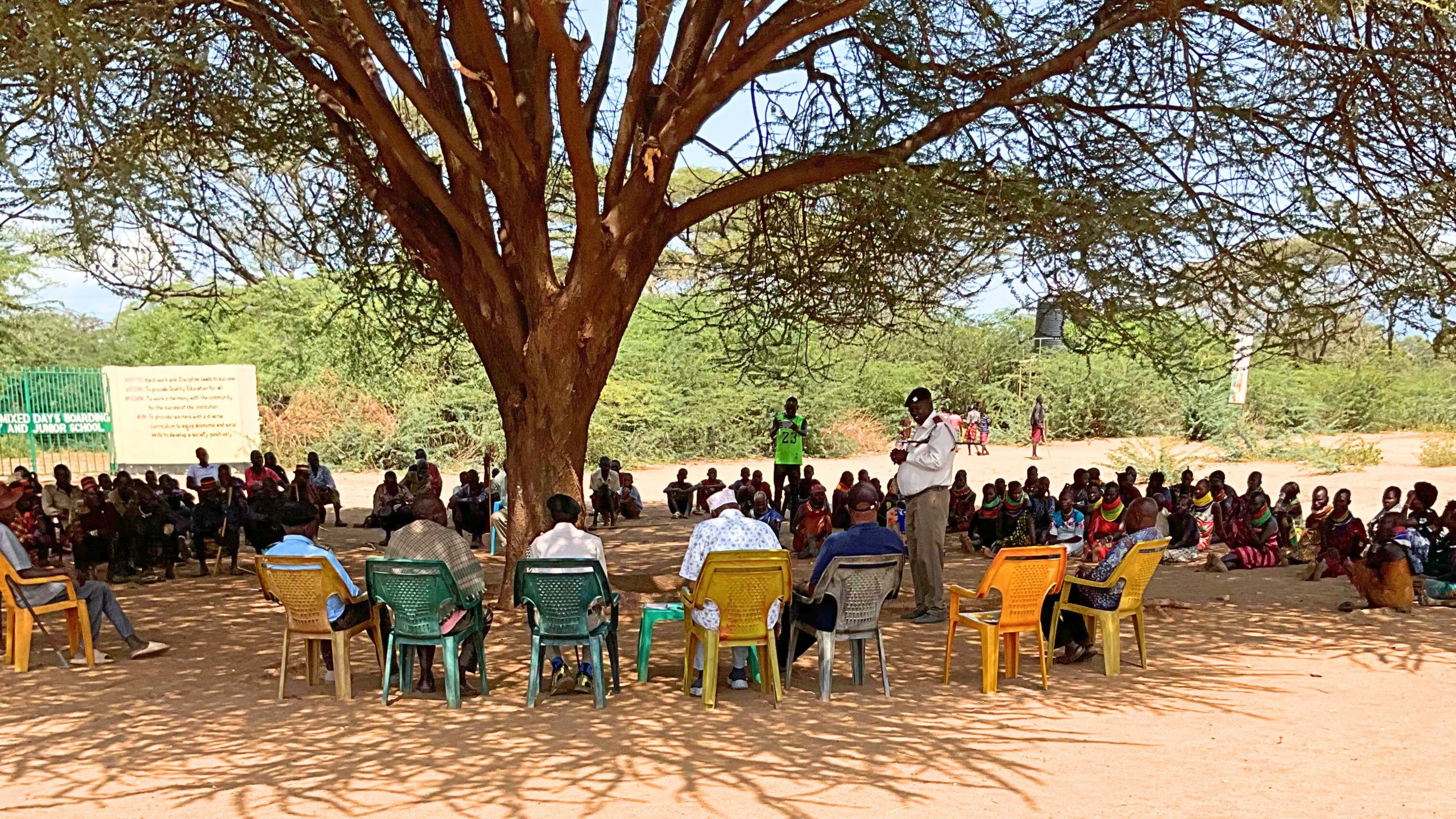
Community engagement session in Turkana County
Devolution’s Unfulfilled Promise- County Governments were meant to dismantle the old patronage networks and give their communities direct control over development priorities. Instead, elected governors’ choice to spawn a parallel power centre, each like a “mini-state”, where they wield unchecked authority over public authority and resources in their counties.
Numerous national audits and oversight authorities reveal repeated patterns of ghost projects, inflated tenders, and cronies lining up at the public trough. County assemblies’ attempt to demand County Executive accountability has practically ended in it being dismantled or compromised. Citizens who once voted for transformative change now watch their children attend half-built schools, dry hospital shelves and wait for drinking water from empty taps indefinitely.
This rot is not accidental; it is structural. Key oversight bodies—county assemblies, the Ethics and Anti-Corruption Commission, the Auditor-General, even the Senate—lack the authority and political will to do the right thing. When impeachment motions surface, the members of the County Assembly sponsoring the motion are defanged by partisan alliances. When court orders curb rogue funds, executives reroute budgets or invoke the national security system to dodge the compliance. Meanwhile, the drylands remain on the brink; Climate shocks, growing chronic poverty, and inter-communal tensions already stretch pastoralist lives to the breaking point.
Devolution’s system malfunction has compounded these stresses: Essential health and water services grind to a halt when counties await delayed national allocations. Land conflicts flare as speculators exploit weak county regulations and unregistered community territories. Meanwhile, civic platforms meant to amplify rural community voices are starved of funds or co-opted by county elites linked to rogue elected officials and politicians. Without urgent reform, the drylands risk becoming zones of perpetual humanitarian crisis rather than engines of resilient and sustainable livelihoods.
Kenya’s devolution experiment commands international attention because it embodies hopes held by many emerging democracies. It has global stakes and shared responsibility for all stakeholders. Donors and development partners continue to pour billions of shillings into county fiscal transfers and capacity-building programs. Yet the returns on investment in the drylands lag far behind national averages. Climate funds, sustainability initiatives, and the Sustainable Development Goals all hinge on robust local governance. When devolution falters in Kenya, the lessons reverberate across Africa, Asia, and Latin America.
Reclaiming the devolution dream demands a dual strategy of rigorous accountability and visionary leadership. We should chart a path to renew the old and reform the new.
1. Constitutional Audit– Convene an independent commission with representation from civil society, faith groups, and academia to review the past 15 years of devolution, identify loopholes, and recommend reforms.
2. Community-Led Oversight Networks– Support pastoralist cooperatives and local watchdog coalitions with digital tools for open budgets, real-time project tracking, and crowd-sourced grievance reporting.
3. Revitalised Inter-Governmental Mechanisms-Empower the Inter-Governmental Relations Technical Committee -IGRTC with financial autonomy and a binding mediation mandate to resolve disputes swiftly.
4. Global Partnership Pacts– Develop targeted funding agreements where international donors tie grants to transparent procurement benchmarks and measurable service-delivery outcomes in the drylands.
Kenya’s drylands are at a pivotal point. The drylands narrative, leadership failures and government actions can either continue to persist in the neglect space and despair, or it must transform to forge a new model for how local systems can empower the world’s most marginalised communities.
The people of Kenya’s drylands must unite to assess the impact of failing devolution on them. Collectively, they should begin to be direct and resolute in demanding full accountability, rebuild community-led institutional capacity, and create clear responsibilities for new leadership in 2027. Only then will the potential of devolution—equity, participation, and shared prosperity—fulfil its full promise, just as it seems to have done on that historic day in August 2010 when the new constitution was launched with much great fanfare by all in Kenya.