#SautizaUtu Linking and Learning event video
DLCI hosted an outstanding annual Linking & Learning event dubbed #SautizaUtu in Watamu, Kilifi County last month. Take a look at how the #WatamuEdition went down here!!
DLCI hosted an outstanding annual Linking & Learning event dubbed #SautizaUtu in Watamu, Kilifi County last month. Take a look at how the #WatamuEdition went down here!!
The Intergovernmental Authority for Development (IGAD) protocol on transhumance is an important legal instrument for the pastoralist people in Kenya to access cross-border water and pasture in the IGAD region. I believe it is time for our country to join the other four member states: Ethiopia, Djibouti, Sudan, and South Sudan in ratifying the protocol on transhumance.
The protocol has come into force after the first four (4) member states have ratified it. Other states that have not yet ratified the protocol are my country – Kenya, Uganda, Eritrea, and the Republic of Somalia. IGAD was established by the agreement that created IGAD in 1996 and Kenya is a signatory. Among other things, IGAD was established to do is allow a cross-border free movement regime for persons, trade in goods and services, customs, right of residence and right of establishment within the member states.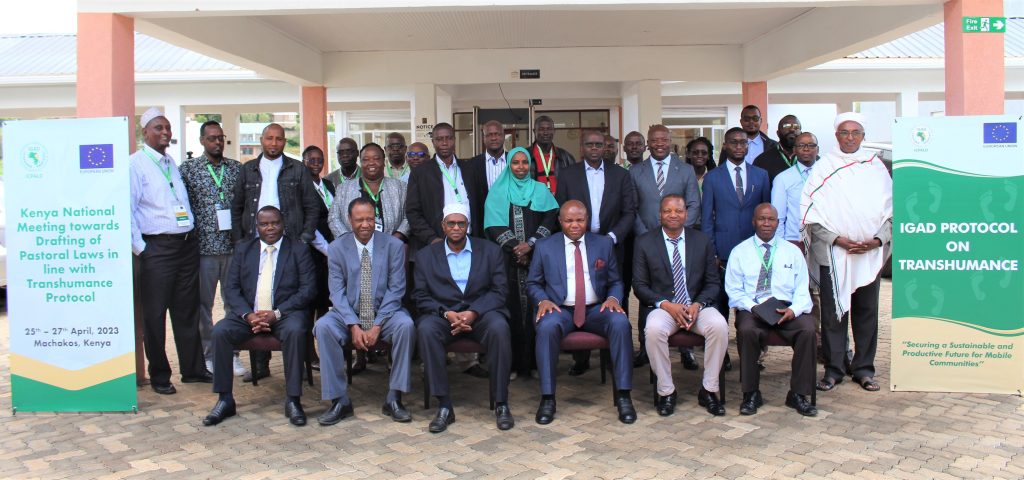
The IGAD region covers an area of 5,209,722KM square and with an estimated population of 239 million people. Livestock is the major driver of the IGAD region’s economy and contributes about 57% of agriculture’s Gross Domestic Product AGDP. Livestock supports 70% of the transhumance population, in terms of their livelihood and employment. According to IGAD Centre for Pastoral Areas and Livestock Development (ICPALD) estimates, the IGAD region has more than 520 million livestock, of which 242 million (35%) are small ruminants.
IGAD has developed the IGAD protocol on transhumance to facilitate the free movement of people and livestock across the IGAD region along with the road map for implementation of the protocol on transhumance that is spread over the period of ten years (2021- 2030) to be implemented in five (5) phases.
1. Adoption, Popularization & domestication
2. Strengthening of good governance for the IGAD cross-Border Clusters
3. Mapping and designation of Cross-Border Corridors and Resources
4. Investment in Transhumance areas and Complementary livelihoods resources
5. Monitoring of Cross- Border Mobility, Community Engagement along Regular pathways, and Reporting.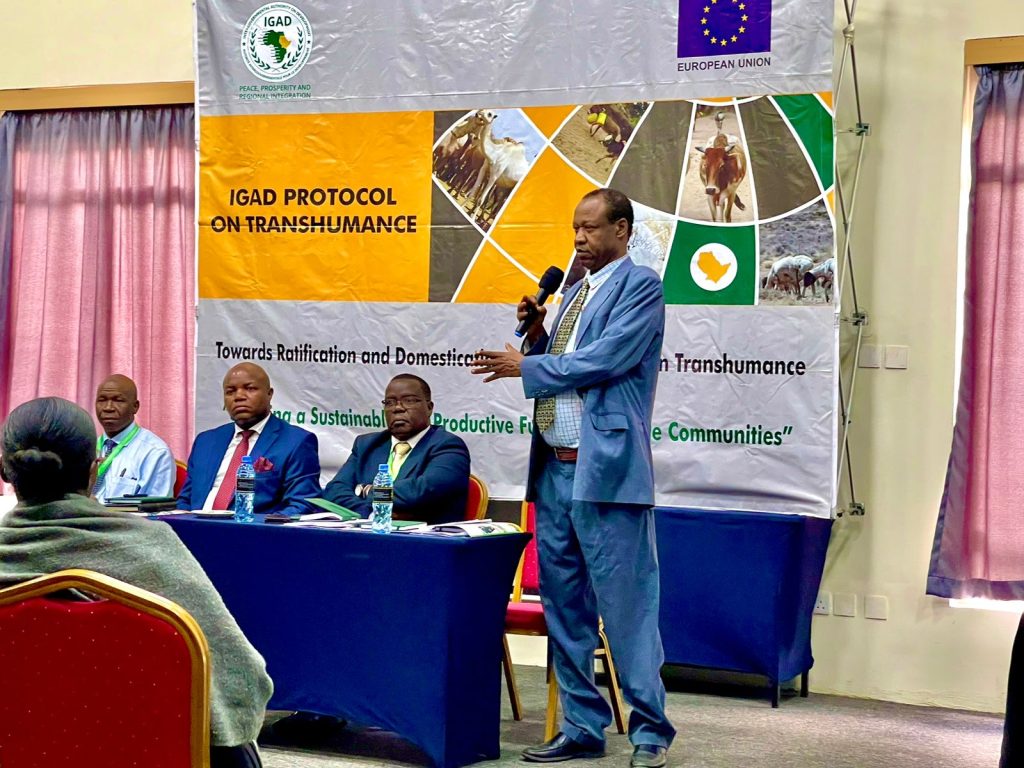
IGAD protocol on transhumance is a very critical regional pastoralism policy initiative that will enhance the development and production of mobile livestock keepers in this vast IGAD region. The conception of the protocol was guided by the key principles, aims and objectives of the IGAD as enshrined in the agreement that established the Intergovernmental Authority on Development (IGAD) 1996 itself in pursuant to Article 17 (a) of the IGAD Agreement. The Member States are expected to execute the delivery of IGAD aims and objectives within the member states areas with substantial livestock and natural resources including artisanal minerals and non-wood forest products that form a critical part of the economies of the IGAD Member States, this protocol is offering the most unique cross border potential for IGAD citizen’s wealth and employment creation, food and nutrition security and economic growth.
The unrestricted mobility of the pastoralist people and livestock is essential for safeguarding and increasing the production and productivity of livestock in response to climate change, variability, and the pressure on existing resources in the Member States that will facilitate the pastoralists to legally cross the borders during the periods of rain failures. The mobility of the pastoralist is the cornerstone of pastoralism production and critical development policy for livestock production in drylands areas. Pastoralism is the main livelihood of the most vulnerable people in the IGAD region who are facing negative climate change impacts, armed conflicts, and environmental fragility. in Kenya, the pastoralist people are facing the worst drought ever recorded in 40 years. the people are facing severe health, security, social, environmental, economic, and political challenges.
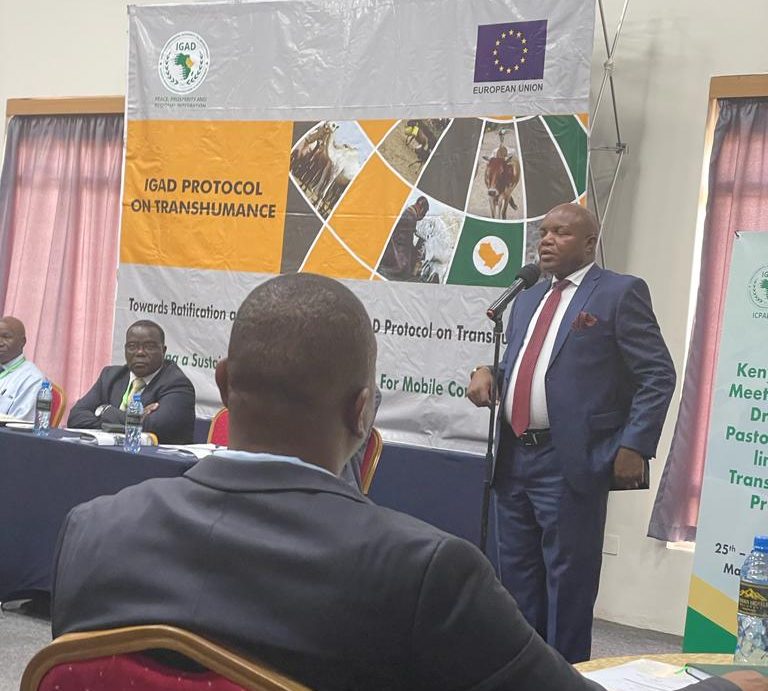
The recognition of pastoralism as a viable system of livestock production in drylands of IGAD is timely action as the protection of pastoralism production is already recognized in other regional policy initiatives; the Nairobi Declaration on Ending Drought Emergencies in the Horn of Africa (2011), the IGAD Conflict Early Warning and Response Mechanism (2002) (CEWARM), Climate Prediction as conducted by the IGAD Climate Prediction and Applications Centre (ICPAC), the Greater Horn of Africa Climate Outlook Forum Climate Prediction (GHACOF), the Nairobi Protocol on the Prevention, Control and Reduction of Illicit Small Arms and Light Weapons in the Great Lakes Region and the Horn of Africa (2004), the Protocol on the Prevention, Combating and Eradication of Cattle Rustling in the Eastern Africa Region (2008). These regional policy initiatives say, strengthening pastoralism as the most viable livelihood in the drylands areas will go a long way in improving livestock production and the value chain.
The IGAD protocol on transhumance fully appreciates the African Union’s goals and priority areas of Agenda 2063 which includes working towards environmentally sustainable and climate resilient economies and communities, the African Union (AU) role of pastoralism in Africa and developing a Policy Framework on Pastoralism in 2010 that aims to secure, improve, and protect the lives, livelihoods, and the rights of African pastoralists, without prejudicing the existing social and cultural systems.
The protocol re-affirms the sovereignty of each member state and its commitment to supporting the existing informal agreements between the border communities. During the recently concluded workshop organized by IGAD in Mombasa that was attended by various parliamentary committees in the Kenya national assembly. The pastoralist leaders called for all the members of the Parliament to pass this protocol as its objective is very important for livestock production in Kenya. They requested members not to focus on text mistakes and other small process omissions on how the protocol was introduced to the Kenyan parliament. Because the parliament has only the option to approve or reject the protocol, the leadership of the Pastoralist Parliamentary group persuaded their colleagues to consider other multiple ways of solving the small process problem of domesticating the IGAD protocol on transhumance to Kenya.
The PPG leadership are concerned that the rejection of this protocol is not good for the pastoralist people of Kenya. acknowledging the issue of process, they said that Kenya could demand specific amendments to this protocol after the parliament has approved it. The members said the parliament must always find out the most productive path to solving a problem than blocking any such progressive policy initiatives that are aimed at benefiting marginal groups like the pastoralists people of Kenya. This is one situation that requires smart work. It is not a sign of laziness if parliament passes this protocol as it is because it is highly applicable considering the huge merit of this protocol than any further delay due to small process issues.
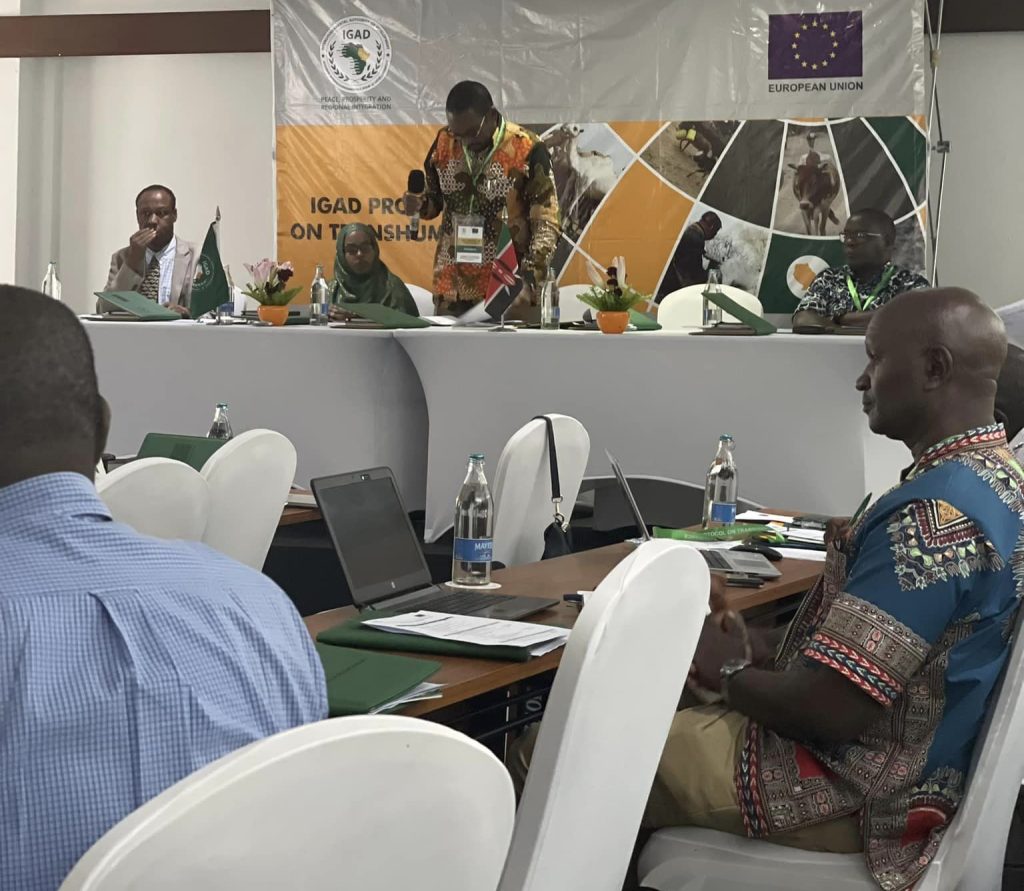
The members of parliament attending the workshop said, there is a need to appreciate and demonstrate that the members of parliament know how to think out-of-the-box in finding an alternative way of solving problems to save time, and money, and boost the overall benefit of such an important legal instrument for the pastoralist people. The challenge with the protocol includes the text that reads wrongly like, the pastoralist is moving around in searching for water and pasture and the wide use of the word ‘pastoral’ to define the pastoralist people. The argument and counter-argument are that pastoralists never move in search of water and pasture when they move when they already know where the water and pasture are. the pastoralist movement is a strategy for accessing the water and pasture resources in the rangelands not for searching. If searching is the reason for movement, it was noted that most pastoralist people and livestock would certainly die if they do not find water and pasture where they move to.
On the use of the term ‘pastoral’. the pastoralist leaders felt this term is not appropriate to define the pastoralist in the IGAD region. What is a pastoral and what is a pastoralist? These two words do not necessarily mean the same thing. Pastoral is a term used in Australia to mean, land, used for the keeping or grazing of sheep or cattle in scattered farms. The second meaning of pastoral is a Christian Church definition that is concerned with giving spiritual guidance, a pastoral Christian doctrine. It was noted that amending even these two words is a long process as the protocol has been ratified by four member states. It may take almost the same time it took to develop the draft.
Therefore, the members persuaded each other to look at alternative options than the path of pursuing further amendment as an appropriate path to finding a better way of solving the problem than rejecting this important regional legal instrument. The national parliament members agreed to focus on the objective of the protocol than focus on issues that may create new obstacles to the ratification of the IGAD protocol on transhumance. Members said, this protocol will get majority support and it will be passed as it is when it comes to the parliament for ratification and domestication. We look forward to our parliament passing the IGAD protocol on transhumances.
End…
Jarso Mokku is the CEO of Drylands Learning and Capacity Building Initiative DLCI & Secretary to the Pastoralist Parliamentary Group (PPG) Secretariat based at the Parliament Building, Nairobi, Kenya
MPs from conflict-hit parts of the country are ready to work with President William Ruto’s government to end the bandit attacks in the North Rift, that have resulted in injuries and killing.
By Collins Omulo
The lawmakers, under the Pastoralist Parliamentary Group, said Thursday that they have decided to set aside their differences in order to rally their communities towards finding a lasting solution to the banditry and cattle rustling menace.
Speaking in Nairobi, the group’s patron, Saku MP Dido Raso, said they have resolved to speak in one voice, despite political or ethnic affiliations, in order to end the perennial conflict in the North Rift, Upper Eastern and North Eastern.
The MP said the 102 lawmakers drawn from the Senate and National Assembly have disassociated themselves from killings and cattle rustling and turned their attention to reaching a ceasefire that will restore peace in the volatile regions.
He said that henceforth, they will not allow the people they represent to engage in conflict with their neighbours in the name of guarding interests.
This, Mr Raso said, is the only way to confront issues including famine, floods, lack of food and the many cases of students dropping out of school.
“We have resolved to put our differences aside and face our problems as one team, partnering with the government, to bring the conflict in our region to an end. We disassociate ourselves from the criminal gangs purporting to fight in our names,” said the MP.
He further said that allegations that elected leaders are behind the insecurity in the North are an excuse previous regimes used to run away from the real issues affecting the region, issues which they should have addressed.
“Leaders have, for a very long time, been used as an excuse by successive governments [in the matter of] conflicts in these areas. However, no leader owns guns or militias, or even sponsors them,” said Mr Raso.
Turkana West MP Daniel Epuyo, the group’s vice patron, asked the government to work with them and adopt the strategies they have come up with to end the long-drawn conflicts.
Mr Epuyo said the pastoralists have been left behind for many years and that the millions of shillings being used in the ongoing security operation in the region could be redirected to buying food and other necessities for residents.
He noted they will no longer allow a few criminal elements to cause animosity in the north.
“We want to make peace amongst ourselves. We cannot be left behind because of our own making. The millions being spent on the multi-agency operation should be going towards helping us as a community,” said the MP.
“We ask the people to end the fighting so that resources can go to more pressing issues. like floods and hunger.”
Tiaty MP William Kamket said the group is calling on the people to embrace a ceasefire as they engage the government on the best way to confront the issues affecting the region.
He asked communities in the affected areas to stop any further attacks.
“We have agreed that moving forward, we shall be speaking in one voice as pastoralists, as we engage the government in finding lasting solutions to issues affecting our communities,” he said.
Originally Published by Daily Nation
NB: DLCI is the secretariat to the Pastoralist Parliamentary Group PPG.
Drylands Learning and Capacity Building Initiative DLCI last week hosted the most successful annual Linking and Learning event dubbed #SautizaUtu in Watamu, Malindi County. The event took place between the 19th to 23rd of March 2023.
The event organized by DLCI in collaboration with the Voice in Kenya team brought together 92 participants from 30 Voice grantee partners including their rightsholders, WE LEAD, Voice in Kenya and DLCI.
 From Left Catherine Natiir, Hillary Kitel, DLCI’s CEO Jarso Mokku, Muhamud Mukhtar and Lilian Lenaiyasa.
The event had two conferencing days with several facilitators both from the grantee partner organizations and external experts. It also included an unconference session on 21st of March afternoon, where grantee partners from Usawa Inc, Mfalme Productions and UPDK shared their best practices, challenges and lessons learnt.
On the 22nd of March 2023, the team visited two grantee partners MADCA and IPD-K where they learnt and shared their experiences. MADCA has a project of protecting the elderly who were to be killed under the guise that they are witches in Kilifi while IPD-K focuses on sensitizing the indigenous communities in Kilifi County to legally own land and utilize it for sustainable community growth and development. The team later had a tour of Malindi town and even visited the infamous Vasco da Gama pillar.

“Let’s give a huge round of applause to Drylands Learning and Capacity Building Initiative for their remarkable efforts in organizing the #LinkingAndLearning event in Watamu! It was an incredible opportunity to bring together Voice grantees, with unique experiences and knowledge, to collaborate and share their insights. This interactive environment truly fostered a space where we could unlearn, learn, and relearn, ultimately unlocking our full potential,” Stretchers Youth Organization wrote on their Facebook page.
“Memories are made of great experiences. We take this opportunity to thank Drylands Learning and Capacity Building Initiative and Voice for the great learning, unlearning and linking opportunity with the other Voice Grantees 2023 during the #LinkingandLearning workshop in Kilifi County Watamu. As an organization we learnt a lot to help us in the implementation of our project,” Health and economic development strategy organization -Hedso wrote.

Jeremiah Nganda, a lecturer at Daystar University and a facilitator at the event said, “Interacting with the participants and listening to conversations made me realize that we have many youth-led organizations doing amazing projects with a goal of transformation in our nation.”

“From pens to adventure, Drylands Learning and Capacity Building Initiative truly captured the essence of #LinkingAndLearning by taking us on a wild ride through the stunning town of Malindi. Our last day at the #LinkingAndLearning event was filled with exciting exploration, valuable networking, and unforgettable experiences shared among like-minded enthusiasts. We immersed ourselves in the local culture, discovered breath-taking sights, and connected with amazing people while forging lifelong relationships. This incredible experience reminded us why we are passionate about learning,” wrote Stretchers Youth Organization.
 Diana Moreka, Voice in Kenya and Tanzania lead, speaking at the annual Linking and Learning event in Watamu, Malindi County.
Beryl Arogo from Ideal Research Centre said, “I enjoyed Watamu. It was a therapeutic time not only just the Linking and Learning that played a huge role in fostering commitment to cause but also because the environment was so rejuvenating. The breeze and the music was therapeutic. I am glad and humbled to have been a part of the team.”
 A co-founder of MADCA explains to the team about the process of rescuing elders ostracised on the guise of being witches in Kilifi.
Big thanks to our incredible partners for their amazing contributions at the #SautizaUtu Annual #LinkingandLearning event in Watamu, Malindi County. A special shout-out to our facilitators for such great sessions. Special thanks to Voice for the continued support both financially and during the planning and execution process. Three days of learning, collaborating, and fun.
“I express my heartfelt gratitude for your support during the #SautizaUtu Annual Linking & Learning event. Your support had a significant impact on making the event a success, and we are truly grateful. Please know that your efforts and support have not gone unnoticed or unappreciated,” said Mr Jarso Mokku, DLCI’s Chief Executive Officer said.
via @citizentvkenya
One Monday evening, I watched as a widow of a police officer in Turkana narrated the pain she went through after she lost her husband in Kapedo in 2015. Consolata Ekeno, the widow of James Lopeyok a police constable lost her husband and sole breadwinner while in the line of duty. A year earlier in 2014, the world was brought to a standstill by reports about the killing in cold blood of 21 police officers and three civilians by bandits in Kapedo area.

By Jarso Mokku
In that year the National Police Service reported that forty-seven police officers were killed and 77 injured in the line of duty. It is indeed paying the ultimate price for making us remain safe. Sadly, the majority of those officers recently killed in the line of duty are youthful guys with promising futures.
The lives of many families have been disrupted by bandits in the pastoralist areas for decades leaving their families distraught. People who have lost relatives like Consolata have been left to fend for her dear children as she painfully mourns the sudden death of her beloved husband. It is a double tragedy.
The consistent banditry attacks in these areas have not only affected people like Consolata alone but millions of others in different ways in these troubled counties that are now rightfully declared; ‘disturbed and dangerous’ by Internal Security Cabinet Secretary Kithure Kindiki. The people in these areas cannot go out to carry out basic things like collecting firewood in the neighbourhoods let alone tend to their farms or herd their livestock without worrying about losing lives. Some people have been shot dead by bandits as they went about herding small goats near their homes, tilling and tending to their modest farms in dry areas in order to feed their children.
Recently the Cabinet Secretary for interior declared Turkana, West Pokot, Elgeyo Marakwet, Baringo, Laikipia, and Samburu Counties as ‘disturbed and dangerous’. The CS revealed that in the past six months, bandits and livestock rustlers have brutally murdered more than 100 innocent civilians and 16 police officers while hundreds had been displaced. This necessitated for the government to deploy the Kenya Defense Forces (KDF) to combat the situation in the troubled North Rift region.
Some of the locals and leadership have expressed confidence and hope that the deployment will deal with the banditry menace. For last 10 years, PPG have been pushing to end cattle rustling and inter community conflict. However, it is known that they are people out there with a different opinion.
Research done by Eva Wangari in 2016 on ‘Trends in Police Militarization, A Case Study of Kenya (2005-2015)’ indicated the military was deployed to resolve conflicts between local populations at least three times in 2014. In May, the army was sent to Mandera County to disarm the local populace. They were dispatched to Marsabit County on September 21 to end the conflict between the Gabra and Borana communities. In November, the army was sent out to Kapedo to end the violence that had resulted in the deaths of 19 police officers and to recover the weapons and ammunition that the bandits had stolen from the officers. This has been the trend for decades in the bandit-prone areas. The government should avoid pitfall of repeating this same mistake by doing same thing in the same way this time.
Wangari further observes in her research that since military personnel are not trained to interact with civilians, they are oblivious to the Constitutionally guaranteed preservation and protection of civil liberties. She adds that although it is true that peace has been restored whenever and wherever the military has been deployed to deal with violent situations within the country, this peace always comes at a high cost. Every time the military has been called in to restore civil order in Kenya, there have been complaints about civil rights violations and violations of citizen freedom. This was observed in the regions of Kapenguria, Marsabit, and Kapedo where human rights violations were documented.

We understand the context of insecurity in the region and this nonsense must come to end. However, what we are saying is that President William Ruto, CS Kindiki and operation commanders should have their ears on the ground, involve local leaders and listen to the people. The communities clearly know the people who are responsible for bringing tensions and who are behind the livestock rustling in their areas but there is intense fear to speak about it for the government in the past does not listen to those little quiet voices even though it carries the answers to the problem. All government needed to do is listen carefully and bring those responsible to book. Collective punishment does not work as it breeds new grievances that will grow the next seed that carry conflict and tensions.
It is obvious and quite agreeable what Sigor MP Peter Lochakapong, one of the new officials of the Pastoralist Parliamentary when he said “the reason pastoralists move from one place to another is to look for water and pasture for their livestock. Let the pastoralist be facilitated to agree on how they are going to live together and use the natural resources in each other territory. For a long time, the pastoralist people have lived together peacefully but it only a few people who have private interests who disrupt the peace among the pastoralist that is now causing chaos in the landscape.” We believe that there is hope and that the pastoralists will continue to interact freely and fend for their livestock and families and share together the scarce resources wherever it is available.
“Open the marginalized areas by constructing access roads, model schools and digging boreholes and water dams.”
Another solution is open the marginalized areas by constructing access roads, model schools and digging boreholes and water dams. The Kenya Defence Forces have adequate equipment that can do an amazing job on this front. They should not only take munitions of weapons and other related weapons and equipment for killing humans that go with the army’s cache of guns and bullets. They should also carry with them other developmental equipment that will open up the access roads, drill boreholes, and construct dams and schools in the isolated areas in order to initiate new social economic projects. This double strategy will change the dynamic on the ground not only ending the banditry but will leave behind memories of the bandit-free zone of areas that were ignored for many years by successive governments since independence. It will breathe fresh air of motivation and enjoyment of development benefits.
Jarso Mokku is the CEO of Drylands Learning and Capacity Building Initiative DLCI and Pastoralist Parliamentary Group (PPG) Secretariat based in Nairobi, Kenya.
Amid acute and persistent drought, pastoralists in Northern Kenya—and other arid regions of Africa—are in dire straits and hinge hope on potential compensation for loss and damage.
By Jarso Mokku

The adverse effects of climate change on human societies and the natural environment are unprecedented. Kenyan pastoralist Job Metuy knows this first hand.
Stench of Death
A resident of Torosei in Kenya’s Kajiado County, Mr. Metuy narrated the anguish of watching 20 of his dairy cows collapse and die from unrelenting heat this past year. He detailed how he covered his nose from the odor of rotting bovine as he dragged their withered corpses to the heaps of other dead livestock that had succumbed to drought.
He said he was battling to save his remaining cattle. “The cows I have left are now like skeletons. They drag themselves through the field, waiting to die.”
Believing the drought would not end in time to save his cows, Mr. Metuy led them across international borders in search of fresh pastures and water in neighbouring Tanzania. But other pastoralists from East Africa had already migrated to Tanzania with their livestock, depleting the pastures and water in that country. With his cows thinner, weaker and without food and water, Mr. Metuy had no choice but to take them back to Kajiado.
On their way, the cattle could no longer walk, so Mr. Metuy borrowed money and hired a vehicle to transport them. On returning, he learned that fellow pastoralists in Kajiado, Garissa, Turkana, and Isiolo Counties were selling their cows at reduced prices, as low as Kshs 2000 ($20).
A need exists for rich countries to deliver on commitments to finance activities that reduce climate emergencies and to protect poor people through financial compensation.
COP27 and Kenya
In November 2022, all eyes focused on Egypt’s coastal city Sharm el-Sheikh where COP27, dubbed Africa’s COP, took place. The theme of the conference was Delivering for People and the Planet.
The conference drew more than 40,000 participants, including heads of state, climate activists, mayors, civil society representatives, CEOs, ministers and negotiators. At stake were the hopes of people around the world, including over a billion people in Africa, a continent disproportionately besieged by the climate crisis.
Kenya’s President William Ruto informed the conference participants of the dire drought in his country. Other Kenyans shared heart-breaking stories of stress and suffering from four brutal seasons of rain failures.
Pastoralism is one of the main economic activities for people in Africa’s arid and semi-arid areas. Practiced by tribesmen for centuries, it is the most viable production system in the drylands. Currently, pastoralism accounts for 90 per cent of youth employment and provides more than 95 per cent of rural family incomes in the drylands of Northern Kenya.
The areas most affected by climate change include Garissa, Isiolo, Kajiado, Turkana, Kitui, Mandera, Marsabit, Laikipia, Samburu, Tana River, and Wajir. The National Drought Management Authority (NDMA) refers to these areas as part of the “alarm stage,” meaning they are experiencing the worst kinds of drought emergency.
The State Department of Livestock confirms that Kenya has lost 2.5 million head of livestock and that the remaining 10 million head in the drylands are suffering without pasture and water.
Tourism Cabinet Secretary Peninah Malonza says that between February and October 2022, 205 elephants perished because of the ongoing drought in protected areas controlled by the Kenya Wildlife Services (KWS).
Kenya also lost 512 gnus, 381 zebras, 12 giraffes and 51 buffalo during the same time in this area, according to Ms. Malonza. No data on the number of deaths is available from the rangeland’s ecosystem where 60 per cent of the wildlife co-exists with the community livestock.
Tackling Climate Change
Researchers link the severity and frequency of natural disasters such as droughts, floods, locust invasions and the COVID-19 pandemic to climate change. They estimate the cost of mitigation and adaptation and compensation for loss and damage to be about $580 billion in 2030 and could be as high as $1.8 trillion by 2050.
Even though wealthy nations and their big corporations are largely to blame for the greenhouse gas emissions that cause climate change, African countries, including Kenya, suffer disproportionately from the effects of climate change. The impact is most severe among poor populations.
Droughts, floods, livestock diseases and armed conflicts are wiping out their livelihoods, underscoring the need for Kenya to help its poorest population adapt by developing sustainable ways of making a living in the drylands.
While the government could engage with rich and powerful nations for assistance in addressing the global crisis, it should prioritize social protections and resilience-building schemes for Kenya’s growing poor population.
Authorities need to mainstream social protections, resilience-building and alternative forms of development interventions for drought emergencies. National and county administrations must mobilize youths from poor communities to implement widespread tree-planting schemes in dryland areas.
As we look forward to COP28, the expectation is that countries, particularly industrialized countries, fulfill their commitments and accelerate efforts to address loss and damage.
A need exists for rich countries to deliver on commitments to finance activities that reduce climate emergencies and to protect poor people through financial compensation. Still, governments must manage their appetite for taxing income going to poor communities from carbon credits earned through the preservation of rangelands.
Post-COP27, we must put pressure on rich nations to cut greenhouse gas emissions and support low-income populations to strengthen resilience and adaption.
If we do not swiftly address the root cause of climate change, conditions will worsen.
The Intergovernmental Panel on Climate Change’s (IPCC) Sixth Assessment Report warns of species’ extinction and reduction and irreversible losses of ecosystems and services, including damage and loss to freshwater, land and ocean ecosystems in Africa. It further predicts a reduction in food production and a massive loss of biodiversity, wildlife, livestock and fisheries.
As we look forward to COP28, the expectation is that countries, particularly industrialized countries, fulfill their commitments and accelerate efforts to address loss and damage.
The lives and livelihoods of pastoralists in the drylands of Northern Kenya and across Africa depend on what these rich countries—and African governments—do next. Delay could prove deadly.
Story originally published by Africa Renewal.
Jarso Mokku is the CEO of Drylands Learning and Capacity Building Initiative and Secretary to the Pastoralist Parliamentary Group Secretariat based in Nairobi, Kenya.
 Dr. Guyo Malicha Roba, leading food security expert and head of the Jameel Observatory for Food Security Early Action, shares how he thinks loss and damage funding could provide the most benefit to African communities suffering from drought. Coming from the Borana pastoralist community in Northern Kenya, Roba brings personal and technical insights to his work with dryland communities.
About 424 million people living in African drylands are currently exposed to recurrent drought or drought-related shocks. Many of the most vulnerable are unable to adapt to significant loss of crops and livestock, with pastoralists and agro-pastoralists witnessing first-hand the escalating trail of destruction left in the wake of five consecutive failed rainfalls in the Horn of Africa.
The current crisis is not unprecedented: it is a new chapter in a long history of droughts in the Horn of Africa, dating back to 2011 when famine killed a quarter of a million people in Somalia. Yet, just over a decade later, and despite various early warnings and alarms over the past two years, the commitment to drought responses has proven half-hearted.
As these droughts intensify and compound, the multidimensional impacts of loss and damage will have catastrophic consequences on pastoralists’ livelihoods and their resilience to future shocks. With such rising needs, we can no longer afford to wait for emergencies to develop. We must act early and pre-emptively to prevent predictable shocks from turning into crises on the scale we are seeing today.
At COP27, in November 2022, we rightly celebrated the commitments made to create a loss and damage fund for vulnerable countries hit hard by climate disasters. Governments are now developing recommendations on how to operationalise the fund and catalyse technical assistance to developing countries. Given the costs of droughts and the failures of the past, the case has never been stronger for a concerted effort to support African drylands to strengthen their early warning systems and capacity for early response to drought.
Loss and damage financing should inject some impetus in the transition from crisis management to prevention. The use of early response tools, that use diagnostic and predictive approaches to monitor, forecast, plan for the impact of droughts will be critical. They can help communities to better project the probability of droughts occurring and plan for how it might affect their livelihoods. These early actions should be deployed along the entire course of the drought cycle, rather than exclusively at the emergency phase, when it is extremely costly. Action needs to be taken now to mitigate the brutal impacts of climate disaster and prevent suffering in the African drylands, but also sustained push to address long term systemic issues.
Funding must also be deployed to improve the use of data in anticipatory action. Poor data remains an impediment to improving the sensitivity and accuracy of early warning systems, hindering how resources are allocated. Recent droughts in Somalia are a notable example of how this can go wrong. A lack of granular and localised data implies that the issues surrounding the drought were dealt with emotionally, rather than with evidence that help in targeting. We should focus on building trust in data-driven approaches, so that decision-making processes can be confidently used when responding in crisis.
More direct funding to local organizations – including women-led organizations – is needed to close the financing gaps that limit community-level action and improve timely local decision-making. Local communities are always the first to respond when preparing for the impact of drought, floods and extreme weather. This was the case at the start of the drought in Kenya, when local actors and officials in Wajir country, acting on warning signs and forecast information, were able to take early action far earlier than most and increase their water and fodder storage to build resilience.
Flexible, predictable, and multi-year funding is critical for long-term drought mitigation strategies. To truly make the impact required from anticipatory action, financing must also focus on resolving the gap between drought design and the organization’s ability to receive and use funds. Long-standing commitments to support local and national response capacity are ultimately a cost saving investment: on average, every $1 spent on early action saves more than $2 in a future costlier emergency humanitarian costs.
The announcement of the loss and damage fund was a step in the right direction, however there is still considerable work to be undertaken in the structuring and allocation of loss and damage funds to ensure it reaches the places that need it most but might have less influence on the decision table. With thoughtful and action-oriented planning, governments have a unique opportunity to transform how African drylands are supported through drought cycles.
Story originally by Environment Journal.
Registration of community land has long been an aspiration for local communities in Isiolo. It is against this backdrop that teams from the County Government executive and the legislature led by County Assembly Speaker Hon. Mohamed Roba, accompanied by Majority Leader and Chair of Land Committee Hon. Major Jillo, CEC Lands & Physical Planning Mr. Yussuf Dahir, County attorney Mr. Hashim met PS Lands & Physical Planning Hon. Nixon Korir on Tuesday.
The Hon. Roba-led team discussed the work plan for community land registration and titling exercise. They also discussed leases for Isiolo Township. Speaking in the meeting, Hon. Roba briefed the PS that the county government of Isiolo was ready and committed to working with the Ministry of Lands to achieve registration of community land.
PS Korir assured the delegation of total support from the ministry and affirmed that a new community registrar would be posted immediately. He also assigned a technical team that is going to work closely with the county government to accelerate the process. The leaders further agreed to fast-track a subsequent meeting with County leadership.
Husna Mubarak FAO representative was also assured of full support towards the digitization of land records and community land registration.
Meanwhile the Drylands Learning and Capacity Building Initiative, Frontier Counties Development Council (FCDC) and Directorate of Land Adjudication of the Ministry of Lands, Housing and Urban developed a detailed work plan for commencing registration of former trust lands for three communities, Kamuthe community in Garissa County and Arsim and Nairimirimo communities in the Samburu county starting from next week.
DLCI has accumulated a lot of working experience from supporting the implementation Community land Act 2016. In 2023 and beyond, DLCI & FCDC jointly with other partners will focus on supporting more community groups to advocate for the full implementation of the Community Land Act.
DLCI will facilitate and increase its efforts towards alternative dispute resolution mechanisms to resolve related community land disputes, especially around the issues of community land boundaries and access to natural resources in the rangelands.
Registration of community land has long been an aspiration for local communities in Isiolo. It is against this backdrop that teams from the County Government executive and the legislature led by County Assembly Speaker Hon. Mohamed Roba, accompanied by Majority Leader and Chair of Land Committee Hon. Major Jillo, CEC Lands & Physical Planning Mr. Yussuf Dahir, County attorney Mr. Hashim met PS Lands & Physical Planning Hon. Nixon Korir on Tuesday.
The Hon. Roba-led team discussed the work plan for community land registration and titling exercise. They also discussed leases for Isiolo Township. Speaking in the meeting, Hon. Roba briefed the PS that the county government of Isiolo was ready and committed to working with the Ministry of Lands to achieve registration of community land.
PS Korir assured the delegation of total support from the ministry and affirmed that a new community registrar would be posted immediately. He also assigned a technical team that is going to work closely with the county government to accelerate the process. The leaders further agreed to fast-track a subsequent meeting with County leadership.
Husna Mubarak FAO representative was also assured of full support towards the digitization of land records and community land registration.
Drylands Learning and Capacity Building Initiative has a lot of experience in Community land, focusing on promoting the review of community land registration regulations and the full implementation of the Community Land Act. It has also increased efforts to resolve land disputes.
Hi! I'm DLCI's AI assistant. What can I help you find today?
Find publications, pages & contacts